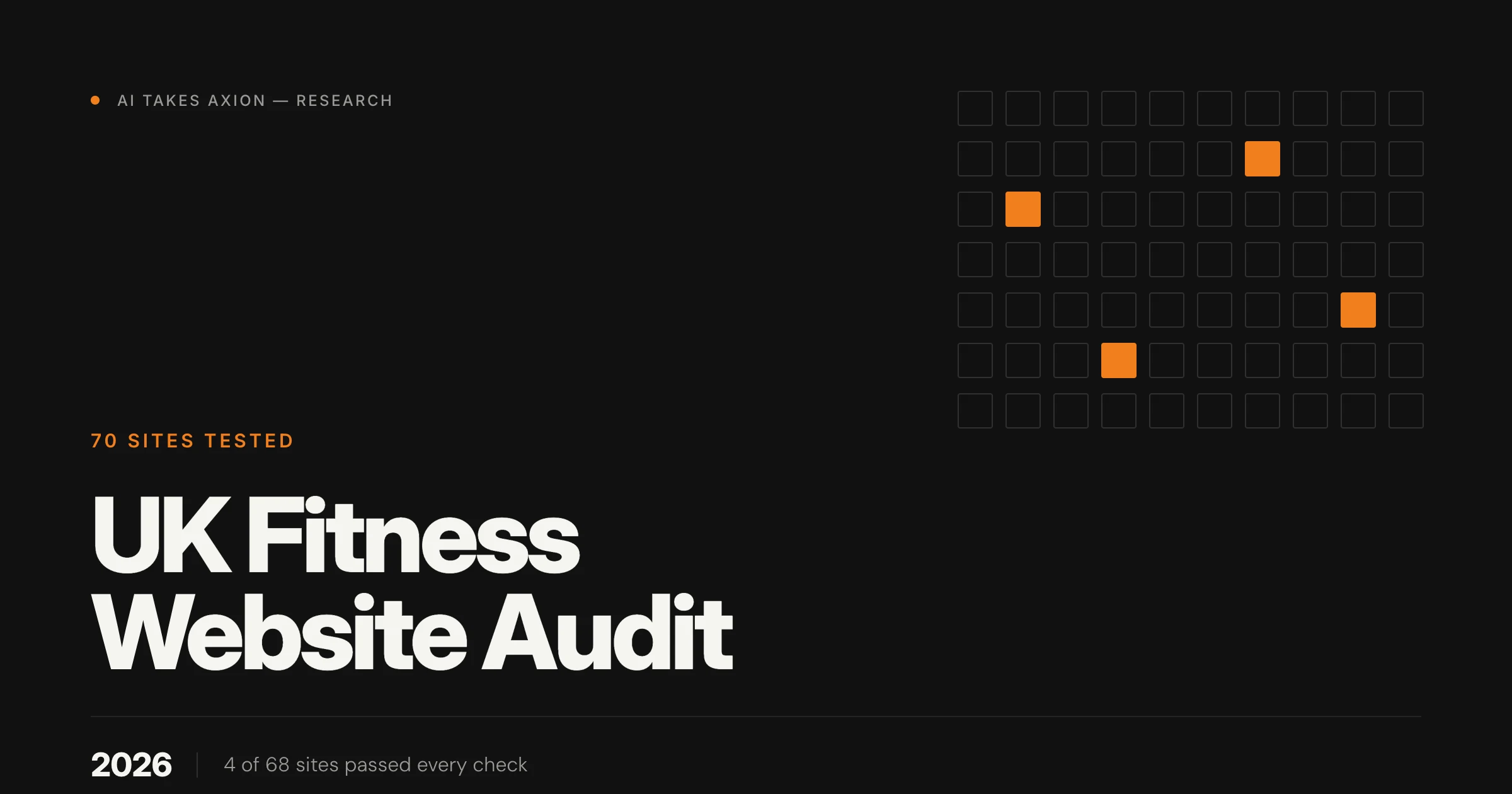
Of the 68 UK fitness websites we could analyse, three had none of the faults we tested for. The other 65 had at least one, and most had several.
Plenty of fitness businesses get everything right except the part nobody can see. Four studios, instructors clients follow by name, and a website Google cannot properly read.
We wanted to know how common that actually is, so we ran the same nine technical checks across 70 UK fitness websites: Pilates and yoga studios, physiotherapy and sports therapy clinics, equipment suppliers and manufacturers, and specialist course providers.
| Fault | Sites | Share |
|---|---|---|
| Studios and clinics with no location markup at all | 21 of 37 | 57% |
| Of those that had some, only one address in it | 12 of 16 | 75% |
| Shops whose product pages carry no price data | 7 of 19 | 37% |
| Test, duplicate or thank-you pages left indexable | 26 of 68 | 38% |
| Missing a meta description on a key page | 24 of 68 | 35% |
| Duplicate or unreadable structured data | 17 of 68 | 25% |
| Stale or broken contact details | 13 of 68 | 19% |
| No structured data of any kind | 9 of 68 | 13% |
UK fitness websites passed all nine checks. Structured data was the weakest area by some distance, and location markup was the single most common gap.
If you run more than one location, start here. Structured data is how you tell Google, in a form it does not have to guess at, that you have a studio in Guildford and another in Farnham and a third in Woking, each with its own address and opening hours. It is what feeds the map results.
Fifty-seven percent of the studios and clinics we checked had none of it. Not a thin version, none. And among the sixteen that did have some, twelve described only a single address, which for a five-site group means four locations are effectively invisible.
The fix is cheap. One block of code per location, built from what is already sitting on the contact page. Nobody has got round to it.
Close to four in ten sites were publishing pages they did not know were public. Nothing private, just clutter. A page titled “Test Memberships”. A form confirmation page. A duplicate studio page someone made while editing and never deleted.
We confirmed each of these was live, returned a normal 200 response, and carried no instruction to search engines to ignore it. One thank-you page was explicitly marked INDEX,FOLLOW, which actively invites Google to list it.
These pages compete with your real ones. They dilute what Google understands your site to be about, and occasionally one of them ranks instead of the page you wanted.
Seven sites in the sample sold training courses with dedicated course pages. Five of the seven had no Course markup on any page we sampled, and the remaining two had it on some course pages but not others.
That matters more here than elsewhere, because Google has a specific way of displaying courses in search results, with price, duration and delivery mode. Without the markup you are not eligible for it. Seven is a small sample and we would not report it as a percentage, but not one of the seven had it applied consistently.
| Platform | Sites |
|---|---|
| WordPress (26 standard, 17 with Elementor) | 43 |
| Wix | 7 |
| Shopify | 7 |
| Squarespace | 3 |
| Magento, Weebly, hand-built or undetected | 8 |
No platform came out clean. WordPress sites usually had duplicate markup from plugins competing with each other. Wix and Squarespace sites had thin markup. The hand-built ones often had none at all. Who built the site matters more than what they built it with.
Seventy UK fitness businesses. Fifty came from our own research into the sector. Twenty were drawn from search results for terms like “pilates studio UK” and “gym equipment supplier UK”, taken in the order they appeared, with no regard for how good or bad the websites looked. National chains, directories and universities were excluded.
Two sites sat behind bot protection that blocked automated requests. Those were excluded from every percentage rather than counted as failures, which leaves 68.
Each check was counted only against the sites it can fairly apply to. An equipment manufacturer in Somerset has no locations to mark up, so it is not counted in the location figures. Product markup is counted only against sites with a shop. This matters more than it sounds: scored naively across all 70, the location figure would read 84%, and it would be wrong.
Every check was validated by hand against sites where we already knew the answer before we trusted any of the numbers, and we have since found and fixed a fault in our own tooling that under-counted two of the checks on seven of the sites. The figures above are the corrected ones, and both moved upwards. Individual businesses are not named, and examples are described loosely enough that they cannot be traced back to a particular company. Every example is real and was verified, but these are small businesses, and the pattern is what matters.
Most of this you can look at yourself in an afternoon.
yoursite.co.uk/sitemap.xml and read the list. Anything with “test”, “copy of”, “draft” or “thank you” in it should not be there.What is location markup, in plain English?
It is a block of code in the page that states your address, opening hours and business type in a format search engines read directly, rather than guessing at from your page text. If you have four studios, you need four of these blocks. It is what feeds the map results, and 57% of the multi-location studios and clinics we checked had none of it.
Does any of this matter if I only have one location?
Less, but some of it still does. The location markup finding is specific to multi-location businesses. Indexable test pages, missing meta descriptions, duplicate structured data and dead contact details all applied across the whole sample regardless of size, and those made up most of the faults we found.
How do I know whether my site has these problems?
Open your sitemap at yoursite.co.uk/sitemap.xml and read the page list for anything with test, draft, copy or thank you in it. Then paste a key page into Google’s Rich Results Test, which shows you what markup Google can actually see. Those two checks take about ten minutes and cover four of the nine faults.
How much does it cost to fix?
Most of these are cheap because the information already exists on the site, it just is not in a form a search engine can read. Location markup is a block of code per site, generated from your contact page. Deleting an indexable test page takes a minute. The work is in knowing which faults you have, which is why we check for free.
We run the same nine checks on request. It takes about twenty minutes and there is no charge for it, whether or not you want us to fix anything afterwards. Send us the address and we will tell you which of the nine apply to your site, with the evidence.
Get your site checked AI Takes Axion
SEO and web design for UK fitness businesses, clinics and independent service businesses. Built to be found, built to convert.