Local SEO for Personal Trainers: How to Rank on Google in Your Area
23 Jun 2026 · Evie Hughes · 10 min read
There are 24,856 personal trainer businesses in the UK. Most of them are invisible on Google.
That’s not an exaggeration. In 2026, 82% of smartphone users run “near me” searches before choosing a local service, and the Google Local 3-Pack,the map and three listings at the top of results,captures 44% of all clicks from those searches. If you’re not in those three spots, you’re invisible to almost half the people who were ready to book.
Most PTs know they should be “doing SEO.” Few know where to start. This guide covers the specific factors Google uses to rank local personal trainers, the steps to improve each one, and what to expect in terms of results,based on the data, not guesswork.
24,856
personal trainer businesses currently competing in the UK
IBISWorld, 2025
44%
of all local search clicks go to the Google Local 3-Pack results
Moz / Backlinko, 2024
32%
of local pack ranking weight comes from Google Business Profile signals
Whitespark, Nov 2025
Key Takeaways
The Google Local 3-Pack appears in 93% of local-intent searches,and captures 44% of all clicks, more than organic results and paid ads combined (Moz/Backlinko, 2024)
Google Business Profile signals are the single largest local ranking factor at 32% of total weight,and complete profiles get 2.3x more search visibility than incomplete ones (Whitespark, Nov 2025 / Google)
In 2026, 74% of consumers only trust reviews written in the last three months, and 47% won’t engage with a business that has fewer than 20 reviews (BrightLocal, 2026)
On-page website signals account for 19% of local ranking weight,your GBP and website need to work together, not separately (Whitespark, Nov 2025)
Why Most Personal Trainers Are Invisible on Google
In 2026, Google’s Think with Google research shows that “near me” and “close by” searches have grown 900% over the preceding two years. When a potential client types “personal trainer near me” or “PT in [your area]”, they expect three local results immediately. If you’re not one of them, the search ends without your name being seen.
The majority of UK personal trainers rely on word of mouth, referrals, and Instagram to get clients. These channels work,until they don’t. Referrals stop when clients move or pause training. Instagram reach fluctuates with every algorithm change. Neither works at 11pm when someone has just decided they want to get fit and is searching for a PT while lying on the sofa.
Here’s a figure most PT guides miss: according to Google’s own data, 86% of Google Business Profile impressions come from category-based searches, not branded ones. That means 86% of the people who could find your GBP listing are searching “personal trainer [city]”,not your name. They don’t know you exist yet. Local SEO is the system that puts you in front of them before a competitor gets there first.
The good news: most personal trainers in the UK have done little or no local SEO work. The market isn’t saturated,it’s under-optimised. A few deliberate steps put you ahead of the majority.
How the Google Local 3-Pack Works (and Why It Gets 44% of All Clicks)
According to Moz and Backlinko’s 2024 local search research, 44% of all clicks from local-intent searches go to the three listings in the Google Local 3-Pack. Sagapixel’s 2024 analysis found this 3-Pack appears in 93% of searches with local intent. Put simply: the map results are where most of the clicks go, and they appear in almost every local search.
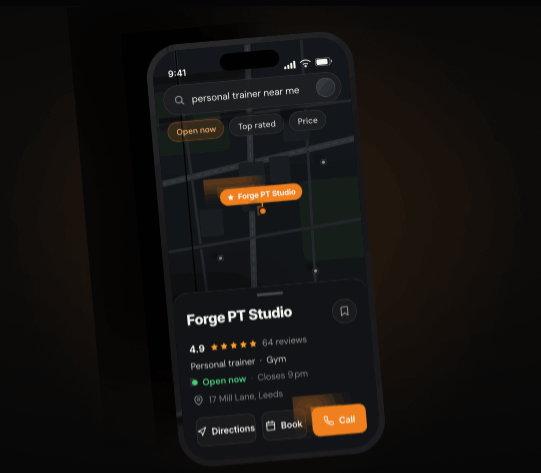
The 3-Pack is the section you see at the top of Google when you search for a local service,a small map with three business listings showing names, star ratings, phone numbers, and distances. Below that sit the organic blue-link results. Below those are any paid ads that didn’t appear at the very top.
For a PT who’s only focused on organic SEO,building a website, writing content,that organic effort captures roughly 29% of available clicks. The 3-Pack captures 44%. Getting into those three local listings is the single highest-return move in local SEO.
The Google Local 3-Pack appears in 93% of searches with local intent, and 44% of all resulting clicks go to those three listings,more than organic results and paid ads combined (Moz and Backlinko, 2024). For UK personal trainers, this means Google Business Profile is not optional: it’s the primary battleground for local client acquisition.
Think with Google’s research also found that 76% of people who run a “near me” search on their phone visit a relevant business within 24 hours. The intent behind these searches is high. People aren’t browsing,they’re deciding. Local SEO positions you to catch them at that moment.
How to Optimise Your Google Business Profile (The 32% Factor)
The Whitespark Local Search Ranking Factors survey (November 2025),the industry’s most-cited annual study of the Google local algorithm,found that Google Business Profile signals account for 32% of local pack ranking weight. That’s the single largest category of factors you directly control. Google and BrightLocal’s joint research found that complete GBP profiles generate 2.3x more search visibility than incomplete listings.
Here’s what to do, in order:
Claim and verify your profile at business.google.com. If you already have one, check it’s verified,unverified profiles don’t rank.
Set your primary category to “Personal Trainer”. Add “Health Consultant” or “Fitness Centre” as secondary categories if relevant to your services.
Complete every field: business name, address or service area, phone number, website URL, and opening hours. Missing fields drag down visibility.
Write your business description with location language. Include phrases like “personal trainer in [area]” or “PT based in [city]” naturally. Don’t stuff keywords,write for a person reading it.
Upload at least 10 photos: a professional headshot, clients training (with their permission), and your training space if you have one. Profiles with photos receive significantly more direction requests and clicks than those without.
Add your services with descriptions and price ranges. Clients want to know what they’re paying before they contact you.
Post on Google weekly. Short updates,a tip, a client result, an availability announcement,signal to Google that your profile is active.
If you train at clients’ locations or outdoors, set a service area rather than a fixed address. Google supports both and uses the service area for local ranking.
In 2025, Whitespark’s Local Search Ranking Factors survey found that Google Business Profile signals account for 32% of local pack ranking weight,the highest-weighted category in the entire algorithm. Profiles with complete information generate 2.3x more search visibility than incomplete listings (Google and BrightLocal, 2025). For a UK personal trainer, GBP is where local SEO work should start.
What we see at AI Takes Axion: When we audit PT websites, an incomplete or unverified GBP is the most common issue we find,and it’s the fix that produces the fastest visible improvement. An optimised site sending traffic to an incomplete GBP listing loses clients at the last step.
One more figure worth noting: Google’s own data shows that 59% of GBP interactions come from mobile users who are ready to call, get directions, or visit. Your GBP is the most-viewed mobile page about your business,it needs to be complete and accurate before anything else.
Why Reviews Are the Fastest Way to Improve Your Local Ranking
Review signals account for 16% of local pack ranking weight (Whitespark, November 2025), but their influence goes further than the algorithm. In 2026, BrightLocal’s Local Consumer Review Survey found that 97% of consumers read reviews before choosing a local business, and 41% say they “always” read reviews before committing.
The recency figure deserves particular attention. Three in four consumers only consider reviews written in the last three months. A PT with 50 glowing reviews from 2022 looks less trustworthy than one with 15 reviews from the past 60 days. This makes review collection an ongoing habit, not a one-off campaign.
In 2026, BrightLocal’s Local Consumer Review Survey found that 74% of consumers only trust reviews written in the last three months, and 47% won’t engage with a business that has fewer than 20 reviews. For UK personal trainers, this means a steady stream of new reviews,two to four per month,matters as much as the total count.
Responding to reviews also matters. The same BrightLocal survey found that 80% of consumers are likely to choose a business that responds to all its reviews, compared to just 42% who would choose one that ignores them entirely. Responding is a positive signal to Google as well as to potential clients reading the reviews.
How to build reviews consistently:
Ask at the moment of best experience,when a client hits a milestone or completes a programme
Send a direct link to your GBP review form via WhatsApp immediately after a session. Remove any friction between the ask and the action.
Aim for two to four new reviews per month. Quantity over time beats a single burst followed by silence.
Respond to every review within 48 hours. One or two sentences is enough.
What Google Actually Uses to Rank Local Personal Trainers
The Whitespark Local Search Ranking Factors survey (November 2025), compiled annually from data submitted by dozens of local SEO experts, breaks the Google local pack algorithm into six weighted categories. Understanding the relative weight of each tells you where to spend limited time.
What most PT SEO guides miss: They tell you to “get reviews” and “fill in your GBP” without saying which factor matters most. The Whitespark data gives you a priority order,so you’re not spending equal time on things that have very different returns.
The six local pack ranking factors, in order of weight:
Google Business Profile signals: 32%,profile completeness, primary category accuracy, keyword usage in your description, Google Posts activity, and photo count
On-page website signals: 19%,location keywords in title tags and headers, name/address/phone consistency, local content on service pages
Review signals: 16%,review volume, recency, average rating, and your response rate
Link signals: 15%,backlinks to your website from local directories, local press, and relevant partners
Behavioural signals: 8%,clicks, calls, direction requests, and time spent on your profile and site
Citation signals: 7%,consistent name, address, and phone number across directories such as Yell, Thomson Local, and Yelp
GBP, on-page signals, and reviews together account for 67% of what Google measures. All three are directly actionable for a PT working without an agency. For most personal trainers who haven’t started yet, this is the priority order: GBP first, reviews second, website signals third.
Citations (directories) are worth sorting but they’re low-priority unless your name, address, or phone number is listed inconsistently across platforms. Inconsistency confuses Google about which information is correct and can suppress rankings.
On-Page SEO: How Your PT Website Sends Local Signals to Google
Your website’s on-page signals are the second-largest local ranking factor at 19% (Whitespark, November 2025). A GBP listing and a website are not separate systems,Google reads both together. Optimising one while ignoring the other leaves ranking potential on the table.
The on-page signals that matter most for local personal trainers:
Title tag with location: “Personal Trainer in [City/Area] | [Your Name]”. Every page should have a unique, location-specific title tag. Generic titles like “Welcome to my PT website” send no local signal.
H1 heading: Match the title intent. State what you do and where,clearly, in the first heading a visitor and Google reads.
NAP consistency: Your name, address or service area, and phone number must appear on your website exactly as they appear in your GBP. Even small variations,abbreviated street names, different phone formats,introduce noise.
Location page per area: If you train clients across multiple areas,say, Ealing and Chiswick,create a dedicated page for each. Write original content for each page. Do not copy the same text with only the area name changed.
LocalBusiness schema: Add JSON-LD structured data to your homepage marking your business type, location, opening hours, and contact details. This helps Google parse your information accurately for both local pack and AI search results.
In 2026, BrightLocal’s Local Consumer Review Survey found that 45% of consumers used AI tools including ChatGPT for local business recommendations,up from 6% in 2025. Structured, factual on-page content optimised for Google also improves your visibility in AI-generated recommendations, making on-page signals increasingly valuable beyond traditional search.
Mobile performance matters here too. Google factors Core Web Vitals into rankings, and 59% of GBP interactions come from mobile users who are ready to act. A site that loads slowly on mobile suppresses both the direct visit rate and the ranking itself.
For a full breakdown of what a PT website needs to convert local search traffic into enquiries, see our guide to personal trainer website design.
Your PT business deserves to be found
We build websites for UK personal trainers that rank locally and convert visitors into enquiries,including GBP setup, on-page SEO, and local schema from day one.
How long does local SEO take for a personal trainer?
For a new or unoptimised GBP, improved local visibility can appear within 60 to 90 days of completing your profile and starting review collection. Ranking consistently in the 3-Pack for competitive searches in a major UK city typically takes four to six months. Review recency and consistent Google Posts activity are the fastest signals to shift.
Do I need a website to rank on Google Maps as a personal trainer?
You can list your GBP without a website, but it significantly limits your ranking potential. On-page website signals account for 19% of local pack ranking weight (Whitespark, 2025). A website also increases behavioural signals,clicks, dwell time, and direction requests,which account for a further 8%. Most serious competitors have both.
How many Google reviews does a personal trainer need?
In 2026, 47% of consumers won’t engage with a business that has fewer than 20 reviews (BrightLocal, 2026). Aim for at least 20 reviews with a 4-star or higher average, then focus on collecting two to four new reviews per month to maintain recency signals. Recency matters as much as volume,74% of consumers only trust reviews from the last three months.
Does posting on Instagram help my Google ranking?
Social media posts are not a direct local ranking factor. Instagram activity does nothing for your GBP position. Time spent on Google Posts, review collection, and website content produces far more measurable ranking improvement than the equivalent time spent on Instagram. Use Instagram for brand awareness,not as an SEO strategy.
What’s the difference between local SEO and regular SEO for personal trainers?
Regular organic SEO targets positions in the standard blue-link results. Local SEO targets the Google Local 3-Pack,the map and three listings above organic results. The 3-Pack gets 44% of clicks for local searches (Moz/Backlinko, 2024), making it the higher-priority target for a PT seeking local clients. Both complement each other, but local SEO produces faster results for a service area business.
Where to Start
You don’t need to do everything at once. The Whitespark ranking data makes the priority order clear: GBP accounts for 32% of your local ranking, reviews account for 16%, and on-page website signals account for 19%. Together those three areas represent 67% of what Google measures. Start there.
Claim, verify, and complete your Google Business Profile this week
Build a system for collecting reviews,two to four per month, consistently
Check that your website title tags include your location and match your GBP details
Add LocalBusiness schema markup to your homepage
Post on Google once a week,it takes five minutes and signals an active profile
If your website needs to work harder alongside your GBP,converting local traffic into real enquiries,start with our guide to personal trainer website design.
Sources
Google / Think with Google, “Near me” search growth research, retrieved 2026-06-22, thinkwithgoogle.com
BrightLocal, Local Consumer Review Survey 2026, retrieved 2026-06-22, brightlocal.com
IBISWorld, UK Personal Trainers,Number of Businesses, 2025, retrieved 2026-06-22, ibisworld.com
ukactive, UK Health & Fitness Market Report 2025 (with Deloitte / 4Global), retrieved 2026-06-22, ukactive.com
Evie Hughes
Head of Digital at AI Takes Axion, a London-based agency specialising in websites and SEO for UK service businesses. Evie helps personal trainers, coaches, and local businesses get found online and turn their website into a client-generating machine.
We use cookies to improve your experience on our site. By using our site, you consent to the use of cookies. Rejecting cookies will prevent non-essential cookies from loading. Cookie Policy & Privacy Policy.
 AI Takes Axion