
Plumbing is the most-searched trade in the UK. Every month, 180,370 people type “plumber” or “plumber near me” into Google – more than electricians, roofers, and locksmiths put together.
The problem is that most of those searches go to the same few businesses in every area. Not because they’re the best plumbers. Because they’ve done the SEO work that puts them in front of those 180,000 searches every month. This guide covers what SEO for plumbers actually means in 2026: your Google Business Profile, the keywords that drive calls, what your website needs to do, and why your review count matters more than you’d think.
In 2025, 87% of UK consumers began their search for a tradesperson on Google, according to the First Step Media 2025–2026 Strategic Marketing Briefing for UK Trades. And 76% of those consumers contacted a tradesperson within 24 hours of that first search. For emergency call-outs – burst pipes, dead boilers, blocked drains – the window is often minutes, not hours.
Plumbing is also the single most-searched trade category in the UK. That 180,370 monthly figure for “plumber” and “plumber near me” outpaces every other trade. Electricians come in second at 133,700. Locksmiths, roofers, and cleaners follow well behind.
Plumbing generates more UK Google searches per month than any other trade category.
What matters, though, is where those clicks go. The Google Local Pack – the map with the top three business listings that appears at the top of local search results – captures 42 to 44% of all clicks for local queries (Backlinko, cited by SeoProfy, 2024). Nearly half the available traffic goes to just three businesses. The question is whether you’re one of them.
Google’s own research – cited in BrightLocal’s Local SEO Statistics hub – shows that businesses with complete Google Business Profiles are 2.7 times more likely to be considered reputable and 70% more likely to attract location visits. Complete profiles are also 50% more likely to lead to a purchase. For a plumbing business, your GBP isn’t optional. It’s the foundation everything else builds on.
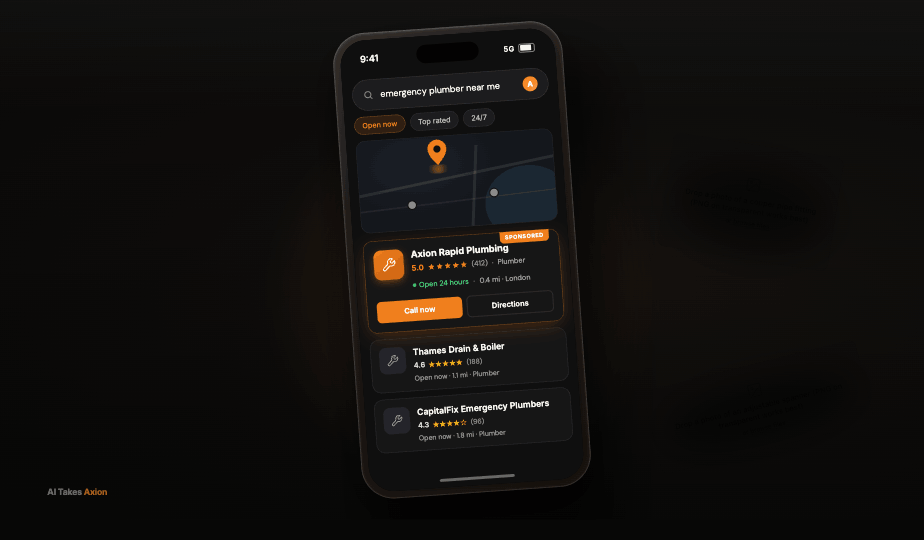
Your Google Business Profile is your most valuable local SEO asset – and most plumbers have it half-finished.
Your primary GBP category tells Google what you do. For most plumbers, that’s “Plumber.” If emergency call-outs are your main income stream, check whether “Emergency Plumber” performs better in your area – you can use it as a secondary category alongside the primary.
GBP lets you list your services directly on the profile: boiler repair, bathroom installation, drain unblocking, central heating, emergency call-outs. Each one is an additional signal that you’re the right result when someone searches for that specific job.
Not stock images. Photos from actual jobs – bathroom installs, boiler replacements, pipe work. Google favours profiles with regular photo uploads, and customers trust them over generic imagery. Phone shots from the job site are better than nothing.
Don’t just add your postcode. Add every town and borough you cover. If you travel a 20-mile radius, every area within that radius needs to be in your profile – or you’ll be invisible for searches outside your immediate location.
The keywords plumbers should focus on aren’t always the ones they’d assume. “Plumber” and “plumbing services” are broad and competitive, often searched by people still browsing rather than ready to book. The terms that drive actual calls are more specific – and far more winnable.
“Emergency plumber [town]”, “24 hour plumber [town]”, “boiler repair [town]” – these are intent-heavy searches from people with an immediate problem. They’re not comparing five quotes. They’re calling the first result that looks legitimate. Ranking here is the highest-value SEO outcome for most plumbers.
“Bathroom fitter [town]”, “new boiler installation [town]”, “central heating installation [town]” bring in larger jobs with longer lead times. They convert more slowly, but the job values are higher.
Adding your town, borough, or city to your target keywords is what makes SEO viable for an independent plumber. You’re not competing with national directories for “plumber.” You’re competing for “plumber in Croydon” or “emergency plumber Bradford” – a much smaller, far more winnable pool.
Type your service into Google and look at the autocomplete suggestions. Those are real searches from real people. Check the “People Also Ask” and “Related searches” sections too. The terms you see there are exactly what your potential customers are typing right now.
A functioning website with your services listed, your service area named, and your phone number visible will outrank no website almost every time. But the plumbers who dominate the organic results below the map have gone further than that.
A single services page tells Google you do plumbing. A dedicated boiler repair page, a bathroom installation page, and an emergency plumbing page each tell Google exactly what you do – and can rank individually for those specific searches. This is the structural win most plumbing sites are missing.
Every service page should include your town or city in the title tag and the main heading. “Boiler Repair in Leeds” ranks in Leeds. “Boiler Repair Services” ranks nowhere specific.
Most plumbing searches happen on mobile. Your phone number needs to be one tap away – not buried in a contact form. A click-to-call button at the top of every page is the highest-converting element on any plumber’s website. Don’t hide it.
For a full breakdown of what makes a plumbing website actually work, see our plumber website design guide.
In 2026, 97% of consumers read reviews before choosing a local business. For home services like plumbing, the bar is higher than most trades. BrightLocal’s Local Consumer Review Survey 2026 found that 47% of consumers won’t even consider a business with fewer than 20 Google reviews. And 31% will only use a business rated 4.5 stars or above – up from 17% in 2025. These aren’t soft preferences. They’re hard filters.
The 47% floor and the 4.5-star threshold are concrete targets – not suggestions.
Reviews are also a direct ranking signal for Google. More reviews at a higher rating push you up in the Local Pack. A plumber with 60 reviews at 4.7 stars will consistently outrank one with the same website and GBP setup but only 8 reviews at 4.2. It’s that straightforward.
Use 20 as your floor – that’s the point where nearly half of potential customers will consider you. Aim for 50+ to compete seriously in larger towns and cities where established businesses have had years to build their count.
The most effective method is a WhatsApp message or text at the end of a job: “Really glad we could sort that – if you’ve got a minute, a Google review would help us out a lot. Here’s the link.” Direct, human, and it converts far better than a card left on the worktop.
A bad review with no response looks worse than the review itself. Acknowledge it briefly, stay professional, and offer to resolve it offline. One calm response signals to every future customer that you’re a business that handles problems – not one that ignores them.
The UK plumbing, heating, and air-conditioning sector is projected to reach £24 billion in 2025, growing at 2.8% annually since 2020 (IBISWorld, cited by AnglianPHE). In a market that size, competition for online visibility keeps rising. Consistent directory listings are how established businesses maintain the edge over newer ones coming up behind them.
UK homeowners don’t only use Google. A meaningful share checks Checkatrade, Rated People, MyBuilder, and TrustATrader before deciding. Being listed consistently on these platforms does two things: it puts you in front of people using those directories directly, and it creates citation signals that reinforce your local authority with Google.
NAP means Name, Address, Phone number. Every directory listing needs to show exactly the same business name, address, and number as your Google Business Profile. Small inconsistencies – “Ltd” versus “Limited”, different phone formats – send mixed signals that can drag down your local rankings over time.
No. Checkatrade is a solid citation and can bring direct enquiries. But it doesn’t replace your own Google presence. Most customers who find you on Checkatrade will still Google your business name before calling – to check your reviews and see your website. You need both working together.
For a deeper look at local citations and map pack rankings, see our local SEO for plumbers guide.
Ready to Get Your Plumbing Business Ranking on Google?
AI Takes Axion builds websites and does SEO for plumbers across the UK. We handle the Google Business Profile, the on-page SEO, the local citations, and the review strategy – so you can focus on the jobs, not the algorithm. No jargon. No long-term contracts.
See Our Plumber SEO Service →How long does SEO take for a plumbing business?
Most plumbers see movement in local pack rankings within 60 to 90 days of optimising their GBP and collecting reviews consistently. Organic website rankings typically take 3 to 6 months, depending on how competitive your local area is and how established your competitors’ sites already are.
Do I need a website, or is a Google Business Profile enough?
You need both. Your GBP handles local pack visibility – the map at the top of local searches. Your website covers the organic results below it. Together, they can occupy the full first page. Most plumbers lose work by having one and not the other, or having both set up poorly.
Is Checkatrade enough to get found on Google?
No. Checkatrade is a useful citation and can bring direct enquiries, but it doesn’t replace your own Google presence. Customers who find you on Checkatrade will almost always Google your business name before calling – to check your reviews and confirm your website looks professional and established.
How much does SEO for plumbers cost in the UK?
DIY local SEO – optimising your GBP, requesting reviews, improving your service pages – costs nothing except time. A professional plumber SEO service typically runs £300 to £800 a month depending on competition and location. See our plumber SEO service for a full breakdown of what’s included.
Plumbing generates more UK Google searches than any other trade – 180,000+ every month that need to go somewhere. The businesses capturing those searches share the same characteristics: a complete and active GBP, 20+ reviews above 4.0 stars, a website with separate pages for each main service, and consistent listings across the UK’s main trade directories.
None of it is complicated. It’s consistent work in the right areas:
If you’d rather hand it over, our plumber SEO service covers everything from GBP setup to on-page optimisation to citation building. And when you’re ready to go further with local rankings, our local SEO for plumbers guide covers the map pack in detail.
Sources
 AI Takes Axion
AI-powered systems that help service businesses capture more leads, convert faster, and scale without the overhead.