Most UK barbershops have an Instagram. Many have a Google Business Profile. Some have a Facebook page from 2019 that still says “DM for bookings.” What most don’t have is a website that actually works.
That’s becoming a problem. In 2024, Mangomint analysed 181,180 barbershop appointments and found 77% were booked online. Walk-ins haven’t disappeared – but they’re no longer the dominant channel. Clients book when it suits them, often late in the evening, and if they can’t do it in a few taps, they move on.
This guide covers the specific elements a barbershop website needs to get clients in 2026. Not a platform comparison. Not a template gallery. Just what actually matters and why.
In 2024, SOCi’s Consumer Behavior Index found that 72% of consumers use Google to find information about local businesses. Google doesn’t rank Instagram profiles in local search results. When someone types “barber in [your town]”, they see Google Maps listings, organic website results, and ads – not Instagram profiles.
That’s the core issue. Instagram is a good way to show your work to people who already follow you. It doesn’t help a new client who doesn’t know you exist find you via Google.
There’s also the GBP dependency. Your Google Business Profile is what surfaces in Maps when someone searches nearby – but most GBP visitors click through to a website before deciding to book. If there’s no website, or if the one they find is slow and outdated, the conversion is lost before it started. The NHBF reported that the UK barbershop sector added 5,791 new units over five years, with 99% being independent shops. Most of those independents have weak or no websites. That gap is an opportunity for any shop willing to build something that works properly.
Instagram is a portfolio. A website is a sales tool. You need both, but only one of them does anything at 10pm when you’re not checking your phone.
For a broader look at bringing in more clients beyond your website, see our guide on how to get more clients as a barber in the UK.
In November 2025, Zenoti surveyed over 1,000 regular salon-goers and found that 71% had decided not to book a business because it was too hard to reach someone or book online. Not 71% who were slightly inconvenienced – 71% who went to a competitor instead, and the original business never knew they’d been considered.
Your website’s primary function is making booking frictionless. Everything else – design, gallery, copy – supports that one job.
What frictionless booking actually means in practice:
The SQUIRE State of Barbershops 2026, based on 13.9 million appointments across 7,000 shops, found that around two in three barbershop bookings now happen via customer self-service – and 25% of those happen between 6pm and midnight. Your phone is off. Your DMs are unread. A booking system on your website captures that demand without you lifting a finger.
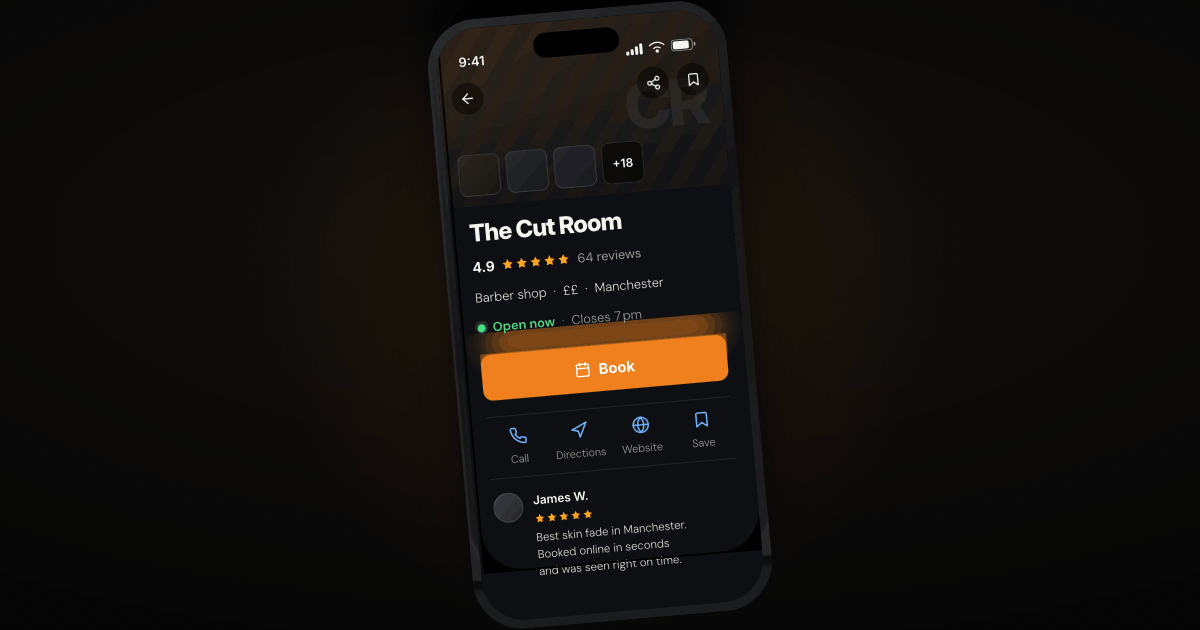
Booking platforms like Fresha, Booksy, and Treatwell can be embedded directly into a website or linked from it. The platform you use matters less than the journey. Can a client book in three taps on a phone? If not, the website is underperforming.
Six elements do the majority of conversion work on a local service business website. Get these right, and the design can be straightforward.
Visible without scrolling, on every device, on every page. Not a “contact us” link. Not a phone number. A direct route to booking. Putting it below the hero section or only on the home page means clients have to look for it – and many won’t bother.
Clients want to know what they’re paying before they commit. Shops that don’t list pricing create doubt before the booking starts. A clear services menu – even a basic one with standard cuts and an approximate price range – removes that doubt early.
Stock photography of men with generic haircuts tells a client nothing about whether you can do what they want. Your own work does. Ten to fifteen clean, well-lit photos of recent cuts show both skill and style range. This is the section that does the job a walk-in browse used to do.
Your website should show exactly when you’re open, and it should match your Google Business Profile. Inconsistencies between the two are common and they erode trust quickly, especially when a client shows up at the wrong time.
In 2024, BrightLocal’s Local Consumer Review Survey found that 75% of consumers always or regularly read reviews before choosing a local business, and 89% say reviews influence their decision to visit. An embedded reviews section or Google reviews widget converts the reputation you’ve already earned with existing clients into new bookings.
An embedded Google Map with a parking note (where relevant) removes the final friction before a first visit. For shops in areas with limited parking or complicated one-way systems, this gets mentioned in reviews more often than you might expect.
What you don’t need: a blog, an animated intro, an extended team biography section, or stock photography. Keep the site focused on converting a visit into a booking.
Google research found that 53% of mobile visitors abandon a page that takes more than 3 seconds to load. For barbershops, where almost all local searches happen on a phone, that translates directly into lost bookings. A site that looks fine on a laptop but crawls on mobile is failing the people most likely to book.
Mobile-first doesn’t just mean the site works on a phone. It means the experience was designed for a phone first. In practice:
Page speed comes down to how the site is built. Overloaded WordPress themes with excess plugins, uncompressed images, and unnecessary JavaScript are the most common causes of slow mobile load times. A purpose-built site on a fast hosting platform will consistently outperform a heavy template, regardless of how the template looks on a desktop screen. This is one area where cutting corners on build quality shows up directly in bookings.
Google data, cited by BrightLocal, shows that businesses with a complete Google Business Profile are 2.7x more likely to be considered reputable by potential clients and 50% more likely to convert to a visit or purchase. But your GBP alone isn’t enough. It’s a discovery layer. Your website is where the conversion actually happens.
Here’s how the loop works when both are doing their job:
The loop breaks at any weak point. A GBP that links to a slow or unhelpful website loses clients at step 3. A website without a booking function loses them at step 4. A business that never responds to reviews misses the authority signal that drives step 6. In 2024, BrightLocal found that 88% of consumers are more likely to use a business that responds to all its reviews – a low-effort habit with a measurable return.
One practical detail that matters: your opening hours, address, and phone number on your website must exactly match what’s listed on your GBP. Any mismatch confuses both Google and the client.
Cost varies considerably depending on how it’s built. Here’s a realistic breakdown of what’s available in the UK market right now:
Cost: £0–£50 per month. You get something live quickly. The trade-offs are template limitations, average page speeds, and weaker local SEO performance out of the box. A good option as a placeholder while you get the business established. Less effective if you’re trying to rank locally or convert cold search traffic.
Cost: typically £300–£800 as a one-off. Quality varies. Some freelancers produce excellent work; others use the same template as several of your local competitors. The main risk is the lack of ongoing support – when something breaks six months later, you may be starting from scratch to find someone to fix it.
Cost: £999–£1,500 setup, with optional monthly retainers for ongoing SEO, Google Business Profile management, and site updates. A properly built agency site should include a custom design built for conversion, fast mobile performance, and a clear point of contact for changes.
At AI Takes Axion, our barber website packages start at £999 for a Starter build and £1,199 for a Growth setup. Full Service packages – which include ongoing SEO and GBP management – are £1,499 setup plus a monthly retainer. Every build is different, which is why we don’t list final prices on the service page, but the above gives you an accurate picture of what you’re looking at.
A barbershop website doesn’t need to be complicated. It needs to do three things well: show up in Google search, load fast on a phone, and make booking straightforward. Most independent barbershop sites in the UK fail at least one of these.
The businesses that sort this early get a compounding advantage. Each booking creates a potential review. Each review strengthens the GBP. A stronger GBP drives more traffic to the website. The loop keeps working without you having to post on Instagram every day to stay visible.
For the full picture on bringing in clients – including GBP strategy, retention economics, and walk-in tactics – read our guide on getting more clients as a barber in the UK.
If you’re ready to sort the website itself, see what we build for UK barbershops.
 AI Takes Axion
AI-powered systems that help service businesses capture more leads, convert faster, and scale without the overhead.