Key Takeaways
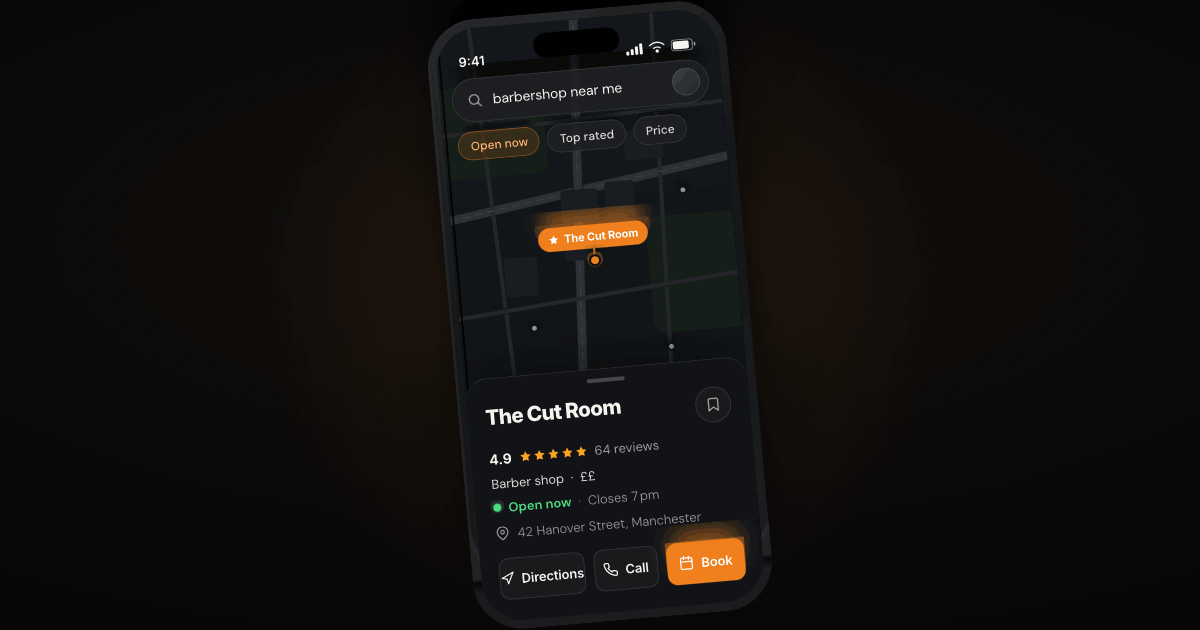
As of 2025, 26% of UK small businesses have no Google Business Profile at all, and 59% have unclaimed profiles, according to data cited by SEOScaleUp from Visionary Marketing. For a barbershop, that’s a direct hit to visibility: when someone searches “barber near me” on their phone, the results are driven almost entirely by GBP listings. No profile means no appearance.
An active, complete GBP generates an average of 81 actions per month: 31 direction requests, 28 website clicks, and 22 phone calls, per Google data cited by SEOScaleUp (2025). Those are clients who were already looking for a barber, found you, and acted. That’s as warm as a lead gets.
To set it up properly: claim and verify your listing at business.google.com, select “Barber shop” as your primary category, fill in opening hours, add your full address or service area, link your booking page, and upload at least 10 photos of your shop and work. Reviews matter too. Ask every happy client to leave one. A listing with 30 genuine five-star reviews will outrank a competitor with a better haircut and no reviews almost every time.
In 2024, Mangomint analysed 181,180 barbershop appointments and found that 77.49% were booked online. If you’re still taking all bookings by phone or walk-in only, you’re not accessible to the way most people want to book. They’re not going to call. They’re going to open an app at 11pm, pick a time, and confirm it in 30 seconds.
UK booking platforms that work well for independent barbershops: Fresha (free to use, takes a commission on paid bookings), Treatwell, and Booksy. Once you pick one, link it directly from your Google Business Profile so clients can book from the search results without ever visiting your website.
One more thing worth knowing: Mangomint’s data showed barbershops have a 14.05% cancellation rate, lower than hair salons (16.96%) and much lower than lash and brow bars (21.52%). If you use a booking platform with automated reminders, you’ll keep that rate even lower.
Nielsen’s research consistently shows that 92% of consumers trust recommendations from people they know above all other forms of advertising. Referrals work. The problem most barbers have is that referrals happen passively: a client mentions you when the topic comes up, or they don’t. A system makes them repeatable.
The best time to ask for a referral is right after a cut that went well, while the client is looking in the mirror and feeling good about it. Not at the end of every session, not via a text three days later. Just: “If you know anyone looking for a barber, send them my way.” That’s it. Most barbers never ask.
A referral incentive helps. A £5 credit off their next cut for every new client they bring in works better than a cash payment (which feels transactional) or a percentage discount (which devalues your pricing). Keep it simple and make it easy to remember.
In February 2025, Ripe Hair and Beauty reported that the average UK men’s haircut costs £13 nationally (from £9 in Stoke to £21 in Edinburgh). At that average, a client who visits every four weeks is worth £169 per year. Every three weeks: £225. Every two weeks: £338. Those are numbers most barbers have never calculated. The chart below shows why retention deserves more attention than acquisition.
The practical implication: encouraging a client to come back a week earlier than usual, or booking their next appointment before they leave your chair, is worth more than acquiring a new client from scratch. New clients require marketing spend and trust-building. A retained client already trusts you.
The simplest retention tactic: at the end of every cut, say “Same time in three weeks?” and book it before they leave. Not a recommendation. A specific time. Most clients will say yes.
If your website isn’t set up properly, the strategies above will underperform. For a full breakdown of what a barbershop website needs to rank and convert, read our guide on barber website design.
Built for barbers. Focused on bookings.
We design and build barbershop websites that convert – fast load times, mobile-first, integrated booking, and full local SEO setup from day one.
See our barber SEO packages →Sources
 AI Takes Axion
AI-powered systems that help service businesses capture more leads, convert faster, and scale without the overhead.