Local SEO for Barbers: How to Rank on Google in Your Area
30 Jun 2026 · Evie Hughes · 9 min read
Most UK barbershops already have a Google listing. The problem isn’t visibility, it’s ranking. Having a Google Business Profile and appearing in the Local 3-Pack are two completely different things, and the gap between them is optimisation.
In 2024, Mangomint analysed 181,180 barbershop appointments and found that 77% were booked online. When a client is ready to book, Google is where they start. The Local 3-Pack, the map and three listings at the top of local search results, captures 44% of all clicks from those searches. If your barbershop isn’t in those three spots, nearly half of all ready-to-book clients never see your name.
This guide covers every factor Google uses to rank local barbershops, in the order that produces the fastest results. Including one angle no other barber SEO guide mentions.
77%
of barbershop appointments are now booked online
Mangomint, 2024
44%
of all local search clicks go to the Google Local 3-Pack results
Moz / Backlinko, 2024
32%
of local pack ranking weight comes from Google Business Profile signals
Whitespark, Nov 2025
Key Takeaways
The Google Local 3-Pack appears in 93% of local-intent searches and captures 44% of clicks, more than organic results and paid ads combined (Moz/Backlinko, 2024)
Google Business Profile signals account for 32% of local pack ranking weight, and complete profiles generate 2.3x more visibility than incomplete ones (Whitespark, Nov 2025)
Fresha, Booksy, and Treatwell listings are citations, inconsistent name, address, or phone across those platforms directly suppresses your Google ranking (Whitespark, Nov 2025)
In 2026, 74% of consumers only trust reviews from the last three months, and 47% won’t engage with a business that has fewer than 20 reviews (BrightLocal, 2026)
Why Showing Up on Google and Ranking on Google Are Different Things
Any business with a physical address gets a Google Business Profile by default. Most barbershops have one. But Google’s own data shows that 86% of Google Business Profile impressions come from category-based searches, not branded ones. Clients are searching “barber in [town]” and Google ranks the results. A default, unclaimed GBP competes against optimised listings from the shop down the road, and it loses.
An unclaimed or incomplete GBP typically has no business description, one or two photos from Street View, no Google Posts, no services listed, and no booking link. That profile is technically “on Google.” It just doesn’t rank anywhere worth being.
What most barber SEO guides get wrong: They write as if barbershops are invisible on Google and need to “get set up.” Most UK barbershops already have a GBP. The real gap is the difference between an unclaimed default listing and an actively optimised one, and that gap determines whether you’re in position one or position nine in your local area.
The Local 3-Pack appears in 93% of searches with local intent (Sagapixel, 2024). The three shops in those spots aren’t there by luck. They’ve done the work. For the majority who haven’t, that’s an opportunity sitting unclaimed.
According to Moz and Backlinko’s 2024 local search research, 44% of all clicks from local-intent searches go to the Local 3-Pack. Organic results get 29%. Paid ads get 19%. The 3-Pack is where clients start, and for most searches, it’s also where they finish.
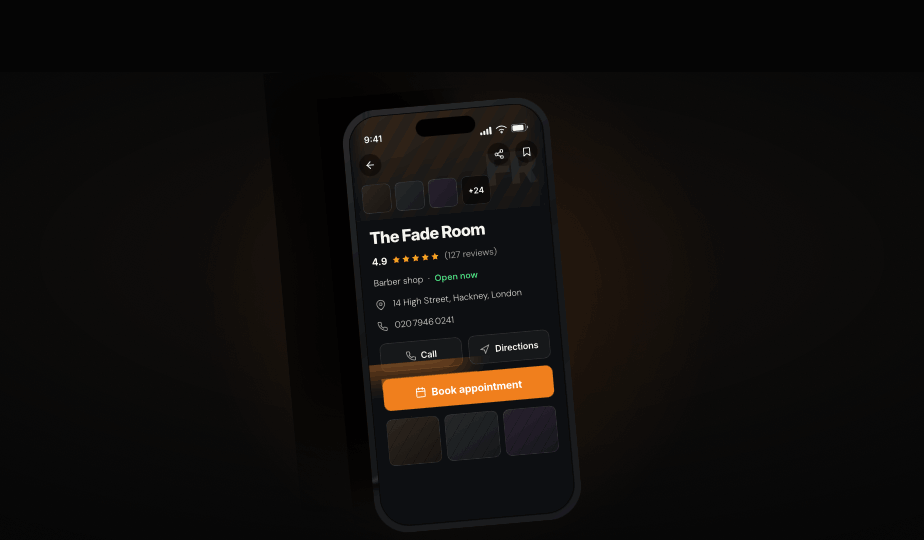
What a 3-Pack listing actually shows a potential client: your shop name, star rating, number of reviews, distance from them, a phone number, and a direct link to your GBP or website. All of that before they’ve visited any website. For many clients, the 3-Pack listing is the only thing they read before deciding to book or call.
The Google Local 3-Pack appears in 93% of searches with local intent and captures 44% of all resulting clicks, more than organic results and paid ads combined (Moz and Backlinko, 2024). For UK barbershops, where 77% of appointments are now booked online (Mangomint, 2024), the 3-Pack is the primary booking channel for new clients who don’t already know your name.
Think with Google research found that 76% of people who run a “near me” search on their phone visit a relevant business within 24 hours. The intent is high. The decision is fast. Your 3-Pack listing is what they’re making that decision from.
How to Optimise Your Barbershop Google Business Profile
The Whitespark Local Search Ranking Factors survey (November 2025) found that Google Business Profile signals account for 32% of local pack ranking weight, the single largest factor category in the algorithm. Google and BrightLocal’s joint research found that complete profiles generate 2.3x more search visibility than incomplete ones. Here’s what “complete” actually means for a barbershop.
Claim and verify your profile at business.google.com. If you haven’t verified it, it won’t rank properly regardless of what else you do.
Set your primary category to “Barber Shop”. Not “Hair Salon” or “Beauty Salon”, the primary category is the single most important field in your GBP. Get it right.
Complete every field: business name, address, phone number, website URL, and opening hours including any different Saturday or Sunday hours.
Write a description with location language: “barbershop in [area]”, “barber in [town]”, “fades and skin fades in [city].” Natural language, not keyword stuffing.
Upload at least 15 photos: shop exterior, interior, your chair, and a portfolio of recent cuts. Update the portfolio regularly. Photos of your actual work are what convert a potential client who’s on the fence.
Add your services with prices: standard cuts, fades, skin fades, beard trims, kids’ cuts, hot towel shaves. Clients want to know what they’re paying before they commit to a visit.
Add your booking link: your Fresha, Booksy, or Treatwell profile URL goes in the “Booking” field. A direct booking path from the 3-Pack listing significantly improves conversion.
Post on Google once a week: a new cut from that week, your availability, a promotion. Short, consistent posts signal an active business to Google and to clients checking your profile.
In November 2025, Whitespark’s Local Search Ranking Factors survey found Google Business Profile signals account for 32% of local pack ranking weight, the highest-weighted category in the entire algorithm. Profiles with complete information generate 2.3x more search visibility than incomplete listings (Google and BrightLocal, 2025). For a UK barbershop, GBP is where local SEO starts and where most of the impact comes from.
What we find at AI Takes Axion: When we audit barbershop websites, an unverified or incomplete GBP is the most common issue we find, and the fix that produces the fastest visible improvement in local rankings. An optimised website pointing to an incomplete GBP loses clients before they ever reach the site.
Fresha, Booksy, and Treatwell Are Local SEO Signals (No Other Guide Covers This)
Citation signals account for 7% of local pack ranking weight (Whitespark, November 2025). A citation is any online mention of your business name, address, and phone number, your NAP. Google uses citation volume and consistency to verify your business is real, located where you say it is, and operating as listed. Traditional citations are directory sites: Yell, Thomson Local, Yelp, Facebook. But your booking platform counts too.
Most UK barbers have at least one of these profiles:
Fresha
Booksy
Treatwell
Yell
Facebook
Each of these is a citation source. Fresha, Booksy, and Treatwell are high-domain-authority platforms that Google trusts. A complete, accurately named listing on each creates strong citation signals automatically. The problem is that most barbers have set up these profiles without checking that the name, address, and phone number match their GBP exactly.
Even small inconsistencies cause problems. “The Fade Room” vs “Fade Room”. “07700 900123” vs “+44 7700 900123”. “High Street” vs “High St”. Google sees these as potentially different businesses and reduces confidence in all of them. That reduced confidence suppresses local rankings.
The fix most barbers are sitting on: Open your Fresha, Booksy, or Treatwell profile right now and compare your name, address, and phone to your GBP. If anything differs, even punctuation or phone number format, correct it. This is a 10-minute task that no competitor in this search result has ever mentioned.
Citation signals account for 7% of local pack ranking weight (Whitespark Local Search Ranking Factors, November 2025). For UK barbershops, booking platforms including Fresha, Booksy, and Treatwell function as high-authority citation sources when the business name, address, and phone listed exactly matches the Google Business Profile. NAP inconsistencies across these platforms suppress local rankings by introducing conflicting signals about the business’s location and identity.
Why Reviews Win Clients Before They’ve Even Walked Through the Door
Review signals account for 16% of local pack ranking weight (Whitespark, November 2025). But in the barbering world, where clients are handing over their appearance to a stranger, reviews carry more weight than in most other local service categories. In 2026, BrightLocal’s Local Consumer Review Survey found that 97% of consumers read reviews before choosing a local business.
The recency figure is the one that catches most barbershops off guard. Three in four consumers only trust reviews from the last three months (BrightLocal, 2026). A shop with 60 reviews from 2022 and nothing recent looks less trustworthy than a shop with 18 reviews from the past 8 weeks. Old reviews aren’t just neutral, they actively reduce confidence.
In 2026, BrightLocal’s Local Consumer Review Survey found that 74% of consumers only trust reviews from the last three months, and 47% won’t engage with a business that has fewer than 20 reviews. For UK barbershops, a consistent stream of new reviews, three to five per month, matters as much as the total count. Recency is a ranking signal and a trust signal simultaneously.
Responding to reviews matters too. In 2026, 80% of consumers are likely to use a business that responds to all its reviews, compared to just 42% who would use one that ignores them entirely (BrightLocal, 2026). A brief response to every review, one or two sentences, signals active ownership to both clients reading the profile and to Google’s algorithm.
How to keep reviews coming in consistently:
Ask at the end of every appointment: “Would you mind leaving us a Google review? I’ll send the link now.”
Send the direct Google review link via WhatsApp within a few minutes of the client leaving
Aim for three to five new reviews per month, volume and recency work together
Respond to every review within 48 hours, positive or negative
On-Page SEO: What Your Barbershop Website Needs to Rank Locally
On-page website signals account for 19% of local pack ranking weight (Whitespark, November 2025). Your website and your GBP aren’t separate systems, Google reads both together and uses consistency between them as a trust signal. Optimising one while ignoring the other is leaving ranking potential unused.
The on-page elements that matter most for barbershop local SEO:
Title tag with location: “Barber in [Area] | [Shop Name]” or “[Shop Name] Barbershop in [Town]”. Every page should have a location-specific title. Generic titles like “Welcome to our barbershop” send no local signal to Google.
H1 heading: states what you do and where, directly. “Barbershop in [Area], Fades, Cuts & Beard Trims” is more useful than “Premium Grooming Experience.”
NAP consistency: your business name, address, and phone number on the website must exactly match your GBP and your booking platform profiles. Every field, every format.
Services pages: if you want to rank for “skin fade [town]” or “beard trim [area]”, you need pages that target those terms specifically. A single “services” page that lists everything rarely ranks well for individual terms.
LocalBusiness schema: JSON-LD structured data on your homepage telling Google your business type, location, hours, and contact details. Google uses this to parse your information for local pack results and AI search recommendations.
Mobile page speed matters here too. Google research found that 53% of mobile visitors abandon a page that takes more than three seconds to load. For a barbershop, where almost every local search happens on a phone, load time is directly tied to how many visitors stay long enough to book.
For a full breakdown of what a barbershop website needs to convert local traffic into actual bookings, see our guide to barber website design.
On-page website signals account for 19% of local pack ranking weight (Whitespark Local Search Ranking Factors, November 2025). In 2026, 45% of consumers used AI tools including ChatGPT for local business recommendations, up from 6% in 2025 (BrightLocal, 2026). Structured, factual on-page content with LocalBusiness schema supports both traditional Google rankings and AI-generated local recommendations.
Ready to rank in your area?
We build barbershop websites that rank locally and work with your Google Business Profile from day one, GBP setup, on-page SEO, and local schema included.
For a new or unoptimised GBP, improved local visibility typically appears within 60 to 90 days of completing your profile and starting review collection. Ranking consistently in the 3-Pack for competitive searches in a UK town or city usually takes four to six months. Review recency and weekly Google Posts are the fastest individual signals to improve.
I rent a chair, can I still rank on Google Maps?
Yes, but the setup is different. If you don’t have a fixed address you can verify publicly, set a service area in your GBP instead. Use your trading name, not the salon’s, as your GBP name. Whatever name, address, and phone you use must match exactly across your Fresha, Booksy, or Treatwell profile and any other directories. NAP consistency applies regardless of whether you have a fixed shopfront.
Should I be on Fresha AND Google, or just pick one?
Both. They serve different purposes. Google Maps is where clients who don’t know you find you for the first time. Fresha (or Booksy or Treatwell) is where they book, return, and leave reviews. Your Fresha listing also creates a citation signal that supports your Google ranking, so being on both with consistent details has a direct SEO benefit that being on one alone doesn’t.
Do I need a website to rank on Google Maps as a barber?
You can rank without one, but your ceiling is lower. On-page website signals account for 19% of local pack ranking weight (Whitespark, 2025), and a website also improves behavioural signals, clicks, dwell time, direction requests, which account for a further 8%. Most serious competitors in any UK town have both a GBP and a website. Having neither leaves you behind; having both gives you every advantage.
My barbershop shows on Google but isn’t getting bookings, why?
Showing up and converting are separate problems. Common causes: fewer than 20 reviews (47% of consumers won’t engage), reviews older than 3 months (74% don’t trust old ones), no booking link in the GBP, portfolio photos that don’t show your actual work, or a website that’s slow on mobile. Start with the GBP: add a Fresha/Booksy link, upload 15 photos of recent cuts, and get 5 new reviews this week (BrightLocal, 2026).
Where to Start
You don’t need to do everything at once. The Whitespark data gives you the priority order:
GBP (32% of ranking weight), claim, verify, and complete your profile this week
Check your Fresha, Booksy, or Treatwell NAP against your GBP, fix any inconsistencies
Start collecting reviews, three to five new ones per month, consistently
Respond to every review within 48 hours
Update your website title tags to include your location
Add LocalBusiness schema markup to your homepage
If you want your website working alongside your GBP, converting local search visitors into booked appointments, start with our guide to barber website design.
Head of Digital at AI Takes Axion, a London-based agency specialising in websites and SEO for UK service businesses. Evie helps barbers, personal trainers, and local businesses get found online and turn their website into a client-generating machine.
We use cookies to improve your experience on our site. By using our site, you consent to the use of cookies. Rejecting cookies will prevent non-essential cookies from loading. Cookie Policy & Privacy Policy.
 AI Takes Axion