Local SEO for plumbers comes down to one thing: the map pack. Those three business listings at the top of a local search take 42 to 44% of all the clicks. Everything else on the page fights over what’s left.
Most plumbers know they should “do local SEO” without knowing what Google actually measures. That’s a problem, because the signals aren’t weighted equally. Some carry three or four times the influence of others, and a few of the biggest ones can be fixed in an afternoon. This guide breaks down the local ranking algorithm as it stands in 2026, in order of how much each factor moves the needle.
In 2026, Google Business Profile signals account for 32% of local pack ranking weight, according to the Whitespark and BrightLocal Local Search Ranking Factors survey published in November 2025 and based on responses from 47 local SEO practitioners. Review signals come second at 20%. On-page signals from your website take 15%. Everything else splits the remaining third.
Google itself describes local ranking as three things: relevance, distance, and prominence. Relevance is how well your business matches what someone searched. Distance is how far you are from them. Prominence is how well-known and well-regarded you are, which Google infers from reviews, links, citations, and general web presence.
Two of those three are things you can build. Distance isn’t. So the practical approach is to max out relevance and prominence, which is what the 32% and the 20% actually represent.
Your Google Business Profile and your reviews together account for more than half of local pack ranking weight.
The same survey ranks individual factors as well as categories. The top five for 2026 are:
Google’s own data, cited in BrightLocal’s Local SEO Statistics hub, shows complete Business Profiles are 2.7 times more likely to be considered reputable and 70% more likely to attract a visit. Combine that with the 32% ranking weight and your GBP is the biggest single lever you own. It’s also free.
Open your profile, go to the business information section, and check what your primary category says. For most plumbing businesses it should be “Plumber.” Then add secondary categories for the work you genuinely do: drainage service, water heater repair service, bathroom remodeller, heating contractor. Secondary categories widen your reach without diluting the primary signal.
Keywords in the business title do carry weight, which is why it’s the third-ranked individual factor. But stuffing your legal business name with keywords you don’t trade under breaches Google’s guidelines and gets profiles suspended. The description field is where you can write naturally about your services and areas without that risk.
GBP lets you itemise services on the profile itself. Boiler repair, drain unblocking, bathroom installation, emergency call-outs, radiator fitting, power flushing. Each entry is an extra relevance signal for that specific search. Most plumbers add two or three and stop.
GBP posts show Google the profile is actively maintained. A short update every couple of weeks is enough: a job you’ve just finished, a seasonal reminder about frozen pipes, a note that you’re taking bookings for bathroom work. The Q&A section works the same way. You’re allowed to ask and answer your own questions, so pre-answer the things customers actually ring up about.
In 2026, review signals account for 20% of local pack ranking weight, up from 16% in 2023 according to the Whitespark and BrightLocal Local Search Ranking Factors survey. No other category has grown that fast over the same period. Reviews are also the one signal you can move measurably in a month.
The consumer side backs this up hard. BrightLocal’s Local Consumer Review Survey 2026 found 97% of consumers read reviews before choosing a local business, 74% want to see reviews from the last three months, and 80% say they’re more likely to use a business that responds to all of its reviews. Recency and responsiveness, not just the star rating.
Recency and responses matter nearly as much as the reviews themselves.
A profile that gained 40 reviews two years ago and nothing since reads as a dormant business. One picking up three to five a month reads as a busy one. That’s the range we aim for with plumbing clients, and it lines up with the 74% recency expectation: at four a month, your most recent reviews are always inside the three-month window customers care about.
Four out of five consumers are more likely to use a business that responds to all of its reviews. Not the bad ones. All of them. Two lines on a five-star review takes fifteen seconds and it’s visible to everyone who reads the profile afterwards. Unanswered reviews, good or bad, read as a business that isn’t paying attention.
A text or WhatsApp at the end of the job works better than anything else we’ve tested. Short, direct, with the link included. Cards left on the worktop convert badly because they need the customer to go and find you later, and nobody does.
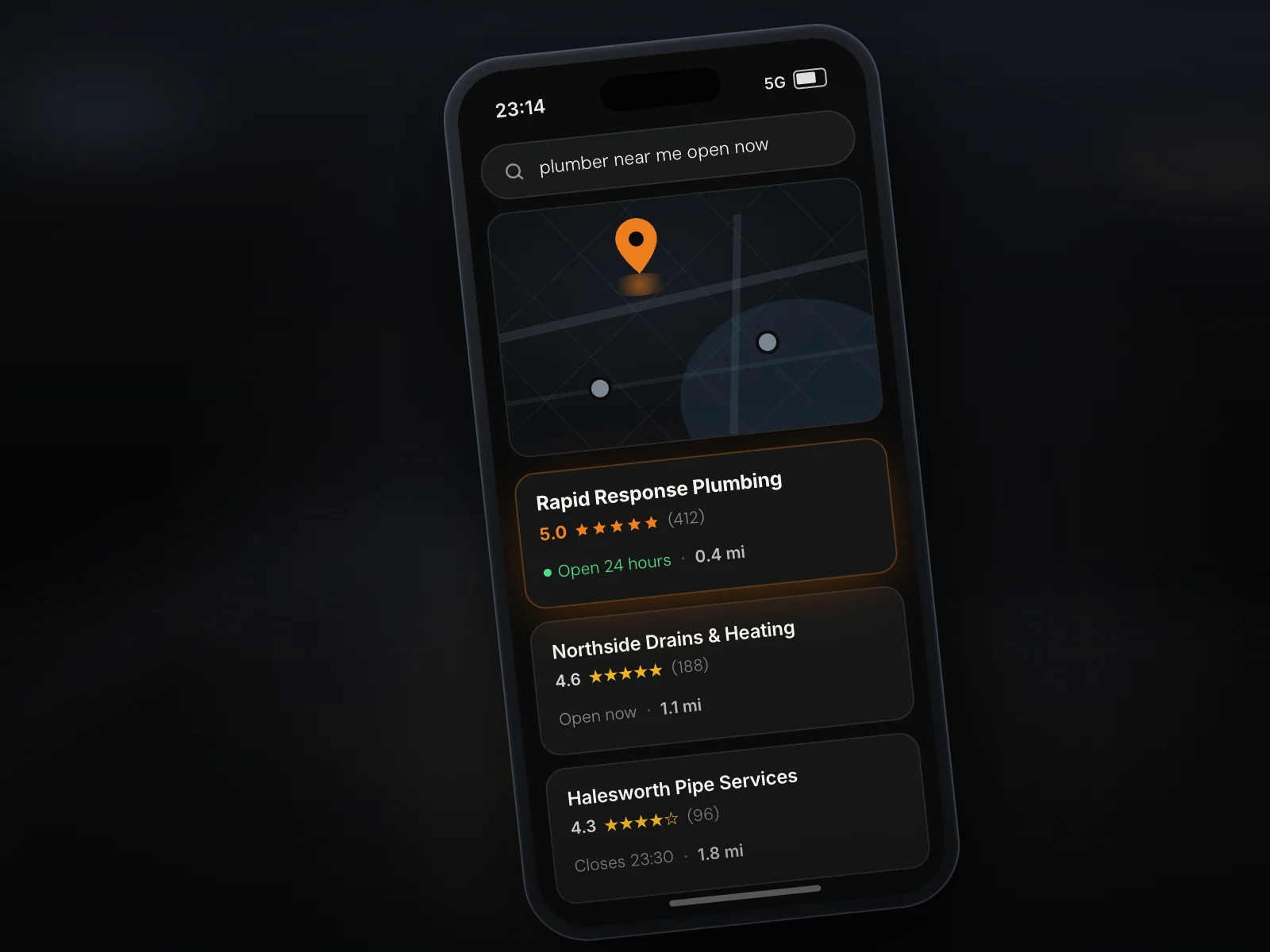
An 11pm search. The top result is 0.4 miles away, rated 5.0, and open 24 hours – three signals working together.
Proximity ranks second among individual local pack factors in the 2026 Whitespark and BrightLocal survey, and it’s the only one in the top five you can’t directly change. What you can do is strengthen every other signal so Google is willing to show you at greater distances. That’s the whole strategy for plumbers who want work outside their immediate postcode.
GBP lets you define your service area either as named towns and boroughs or as a radius. Name them. A list of specific places gives Google explicit, unambiguous terms to match against, and it’s how you show up for “plumber in [town]” searches in areas you cover but aren’t based in. Add every one you genuinely travel to.
Having a physical address in the city being searched is the fourth-ranked individual factor. For a plumber based just outside a major city, that’s a real disadvantage and there’s no trick around it. What there is: everything else. Category, reviews, on-page content, and citations are all still fully available to you, and they add up to more than 60% of the algorithm between them.
On-page signals from your website are 15% of local pack weight, and location pages are how you use them. A page for each main town you serve, with genuinely different content on each, tells Google you’re relevant to searches in those places. Six near-identical pages with the town name swapped won’t work. Mention local landmarks, the kind of housing stock, jobs you’ve done there. Our website design for plumbers guide covers how to structure these properly.
BrightLocal’s Local Business Discovery and Trust Report found 62% of consumers would avoid using a local business if they found incorrect or inconsistent information about it online. Citation signals are only 6% of local pack weight, so this isn’t where rankings are won. It’s where they quietly leak.
NAP stands for Name, Address, Phone. When those three details appear differently across the web, Google has to decide which version to trust, and inconsistency reduces confidence in all of them. It’s a drag rather than a penalty, but it’s a drag that compounds over years of listings you’ve forgotten about.
Search your business name in quotes, then search your phone number on its own. Both will surface listings you’d forgotten existed. Write down every version of your details you find, pick the one on your GBP as the master, and work through fixing the rest. It’s dull and it’s finite, which is the best kind of SEO job.
Checkatrade, Rated People, MyBuilder, and TrustATrader are the ones UK homeowners actually search. Yell and Bing Places carry citation value even where direct traffic is thin. Get those six right and you’ve covered the meaningful ground. Our SEO for plumbers guide has the full directory breakdown.
Behavioural signals make up 9% of local pack ranking weight in the 2026 Whitespark and BrightLocal survey. Small on paper, but one of them sits in the top five individual factors: whether your business is open at the time someone searches. For emergency plumbing, that’s a bigger deal than the 9% suggests.
Set the hours you genuinely work, including evenings and weekends if you cover them. Add special hours for bank holidays. If you run a 24-hour emergency service, set the profile to 24 hours. Most burst pipes and dead boilers don’t happen on a Tuesday afternoon, and “emergency plumber near me” at 11pm is a search you can only win if your profile says you’re open.
Regular photo uploads tell Google the profile is live. Phone shots from real jobs beat stock images every time, both for the algorithm and for the customer deciding whether to ring you. A handful a month is plenty.
Turning on GBP messaging and booking gives customers more ways to make contact from the profile itself, and those interactions are engagement signals. One caveat worth taking seriously: if you switch messaging on and don’t reply, Google can disable it. Only enable what you’ll actually monitor.
BrightLocal’s consumer search behaviour research found 46% of consumers always or often add “near me” to local searches. You don’t optimise for the phrase itself. You optimise for the signals Google uses to answer it, which is everything above.
Want to Be in the Top 3 for Plumbing Searches in Your Area?
AI Takes Axion handles local SEO for plumbers across the UK. Google Business Profile optimisation, review strategy, citation cleanup, and the on-page work that pushes you up the map pack. We focus on the signals that actually carry weight, and we tell you which ones we’re moving.
See Our Local SEO for Plumbers →What is the Google local pack and why does it matter for plumbers?
The local pack is the map with three business listings that appears at the top of Google for local searches. It captures 42 to 44% of all clicks on those queries, more than any other part of the results page. Getting into it is the highest-value local SEO outcome for most plumbing businesses.
How long does it take to rank in the Google local pack?
Most plumbing businesses see map pack movement within 60 to 90 days of optimising their Google Business Profile and collecting reviews consistently. Category corrections and review growth move fastest. Citation cleanup takes longer to register, and website changes typically show up over three to six months.
Does my plumbing business need a website to rank in the local pack?
You can rank in the map pack with a Google Business Profile alone. But on-page signals from your website are 15% of local pack ranking weight, and a site is what gets you into the organic results below the map. The two together can occupy the whole first page.
How many Google reviews does a plumber need to rank locally?
There’s no fixed number, but 47% of consumers won’t use a business with fewer than 20 reviews (BrightLocal, 2026). Treat 20 as the floor and 50+ as competitive in larger areas. Velocity matters too: three to five new reviews a month keeps the profile reading as active.
Nearly half the clicks on local plumbing searches go to three businesses. Getting into that three is the single highest-value thing local SEO can do for you, and the algorithm behind it is more knowable than most plumbers assume. Over half the weight sits in two places you fully control: your Google Business Profile and your reviews.
In order of impact:
If you’d rather hand it over, our local SEO for plumbers service covers all of it. And for the wider picture of how SEO works for a plumbing business, including keyword research and website structure, start with our SEO for plumbers guide.
Sources
 AI Takes Axion
AI-powered systems that help service businesses capture more leads, convert faster, and scale without the overhead.