
Someone recommends you to a neighbour. The neighbour still Googles you before they ring. That second step is where most plumbing websites lose the job they were handed for free.
Website design for plumbers gets talked about as though it were a branding exercise. It isn’t. The person landing on your site has already decided they need a plumber. Your only job is to stop anything getting between that decision and the phone call. This guide covers what actually does that, starting with the thing that costs plumbers the most work and gets written about the least.
In 2026, 73% of UK homeowners searched for a tradesperson online before making contact, even when they had already been given a personal recommendation, according to Harri Digital’s guide Website for Tradespeople UK 2026. So the referral doesn’t close the job. Your website does.
That’s a different situation to almost any other kind of small business site. A restaurant is trying to make you hungry. A consultancy is trying to establish credibility over weeks. A plumber is being checked out by someone who is already sold on needing a plumber, often standing in a room with water in it.
So does a Google Business Profile cover it? Plenty of plumbers assume so. It doesn’t. In 2026, BrightLocal’s Local SEO Statistics found that 56% of Google Business Profile interactions end in a website visit, against 24% that end in a phone call. Even for a business found entirely through the map, most people go to the website next.
Most map pack interactions don’t end in a call. They end on your website.
In 2026, BrightLocal found that 88% of people who ran a local search on a smartphone visited or called a business within the week. For emergency plumbing the window is far shorter than that. If you want the wider picture of how people find you in the first place, our local SEO for plumbers guide covers the map pack in detail.
In 2026, the average mobile page took 8.6 seconds to load against 2.5 seconds on desktop, according to We Are Tenet’s Website Speed & Page Load Time Statistics. And 53% of mobile visitors abandon a page that takes longer than three seconds. On an emergency search, a slow site and no site produce the same outcome.
The drop-off isn’t gradual either. Google’s own data, published via Think with Google, shows the probability of a visitor bouncing rises 32% when load time goes from one second to three. Push it to ten seconds and that probability rises 123%.
Not absolute bounce rate – the increase in how likely a visitor is to leave, measured against a one-second load.
Almost always the same four things. A hero photo uploaded straight off a phone at 4MB. A page builder loading its whole framework to render five paragraphs. A carousel nobody swipes. And four or five tracking scripts added over the years and never removed.
Put your homepage into Google PageSpeed Insights and read the mobile tab. Desktop scores flatter you and hide the problem. In 2026, 64% of mobile users expected a page to load in under four seconds, so treat anything above three as work to do.
Is a fast site enough on its own? No. But a slow one makes everything else here irrelevant.
In 2026, 94% of first impressions came down to website design, and visitors form that impression in roughly 50 milliseconds, according to Loopex Digital’s Web Design Statistics. On a plumber’s site there’s only one thing that impression needs to produce: a tap on your phone number.
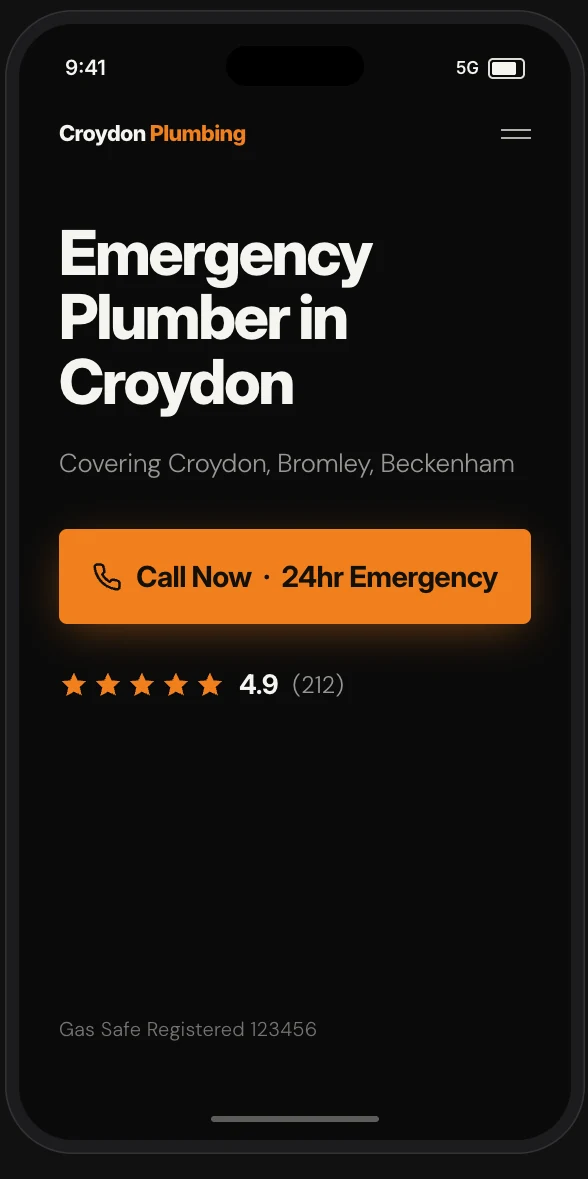
Service area, click-to-call, live reviews and your Gas Safe number, all visible without scrolling on a 375px screen.
Three things earn that tap. None of them is a logo.
Your phone number needs to be a real link, written as <a href="tel:...">, sitting in the first thing a visitor sees. Tapping it should start the call. That sounds too obvious to state until you check how many trade sites fail it.
Name the towns and boroughs you cover in words, near the top. Put them in text, where they load instantly and Google can read them. Someone in Beckenham needs to see “Beckenham” to know they’ve found the right plumber.
If you take calls at eleven at night, that belongs above the fold too. It’s the single most useful thing you can tell an emergency searcher, and most plumbers bury it on a contact page.
What doesn’t belong up there: a rotating carousel, and stock photography of pipes that aren’t yours. Neither helps produce the tap. For how these pages fit your wider search presence, see our SEO for plumbers guide.
On-page signals from your website account for 15% of Google local pack ranking weight, according to the Whitespark and BrightLocal Local Search Ranking Factors survey published in November 2025. Page structure is how you actually use that 15%, and it’s where most plumbing sites leave it on the table.
A single “Services” page tells Google you do plumbing. Separate pages for boiler repair, drain unblocking, bathroom installation and emergency call-outs each tell it something specific, and each can rank on its own for that search. One page becomes five, and five have five times the surface area.
A page per town works, but only if the content genuinely differs. Six pages with the town name swapped and everything else identical is a doorway pattern, and Google treats it as one. Write about the housing stock and the jobs you actually do there.
Each service page should link to the towns you offer it in, and each town page back to the services. It takes ten minutes and it’s the difference between a set of orphan pages and a structure Google can follow. Our local SEO for plumbers service covers this alongside the profile work.
In 2026, 75% of people judged a business’s credibility on its website design, and 48% named design as the single biggest factor in deciding whether a business could be trusted, according to Loopex Digital’s Web Design Statistics. For a trade where the customer is about to let a stranger into their home, that bar sits higher than most.
Why should design carry that much weight? Because it’s the only proxy a homeowner has before they meet you.
Your Gas Safe registration number if you hold one. CIPHE membership. Public liability cover. These are the things a homeowner checks for and the things a rogue trader can’t produce. Put the actual numbers on the page. A logo on its own proves nothing.
Embed your Google reviews live so they update themselves and are visibly real. A screenshot of five-star ratings from 2023 does the opposite of what you want. And 47% of consumers won’t use a business with fewer than 20 reviews, so the count matters as much as the score.
Just the call-out fee and how you charge after it. Say nothing and the homeowner assumes you’re hiding something, then rings the competitor whose site answered the question. It’s the easiest trust win here and hardly anyone takes it.
There are three realistic routes, and all of them can work. A DIY builder runs £0 to £50 a month plus a weekend of your time. A freelancer typically charges £300 to £800. A purpose-built site with local SEO from day one starts at £349 with us. The cheapest option is only cheap if it converts.
Wix, Squarespace and the rest will get you online this weekend. They’re a reasonable placeholder if you currently have nothing. The trade-off is speed and control: templates carry weight you can’t strip out, and mobile scores suffer for it.
Quality varies more than price does. Ask for the mobile PageSpeed score of two sites they’ve already built before you agree anything. If they can’t or won’t give you a number, you’ve learned what you needed to know.
The “free website” bundled with some directory memberships often isn’t indexable, or sits on the directory’s domain instead of yours. That builds the directory’s search presence. If you can’t find it on Google by searching your business name, it isn’t doing the job. Once the site is built, our plumber SEO service is what gets it ranking.
Want a Plumbing Website That Actually Books Jobs?
AI Takes Axion builds websites for plumbers across the UK. Mobile-first, fast on 4G, click-to-call above the fold, a separate page for every service you offer, and local SEO set up from day one. £349 build, no lock-in.
See Our Plumber Website Design →What should a plumber’s website include?
A click-to-call number above the fold, your service area named in words, a separate page for each main service, your Gas Safe or CIPHE number, live Google reviews, and out-of-hours availability if you offer it. Speed matters more than any of it – 53% of mobile visitors leave after three seconds.
Do I need a website if I already have a Google Business Profile?
Yes. BrightLocal’s 2026 data shows 56% of Google Business Profile interactions end in a website visit, against 24% that end in a call. Your profile gets you found; the website is where most people go next to decide whether to ring you.
How much does a plumber website cost in the UK?
DIY builders cost £0 to £50 a month. Freelancers typically charge £300 to £800. A purpose-built site with local SEO included starts at £349 with us. What decides it is whether the finished site loads fast on mobile and makes calling you one tap.
How fast should a plumbing website load?
Under three seconds on mobile, ideally under two. The 2026 average is 8.6 seconds and 53% of visitors abandon past three. Test yours in Google PageSpeed Insights on the mobile tab, because desktop scores hide the problem.
Nearly three quarters of homeowners check you online before they ring, even when someone has already vouched for you. Your website closes the job the referral started. And most of what decides it comes down to speed and one working phone link.
In order of what costs you the most work:
If you’d rather hand it over, our plumber website design service covers all of it. And once the site is right, our SEO for plumbers guide and local SEO for plumbers guide cover getting it found.
Sources
 AI Takes Axion
AI-powered systems that help service businesses capture more leads, convert faster, and scale without the overhead.